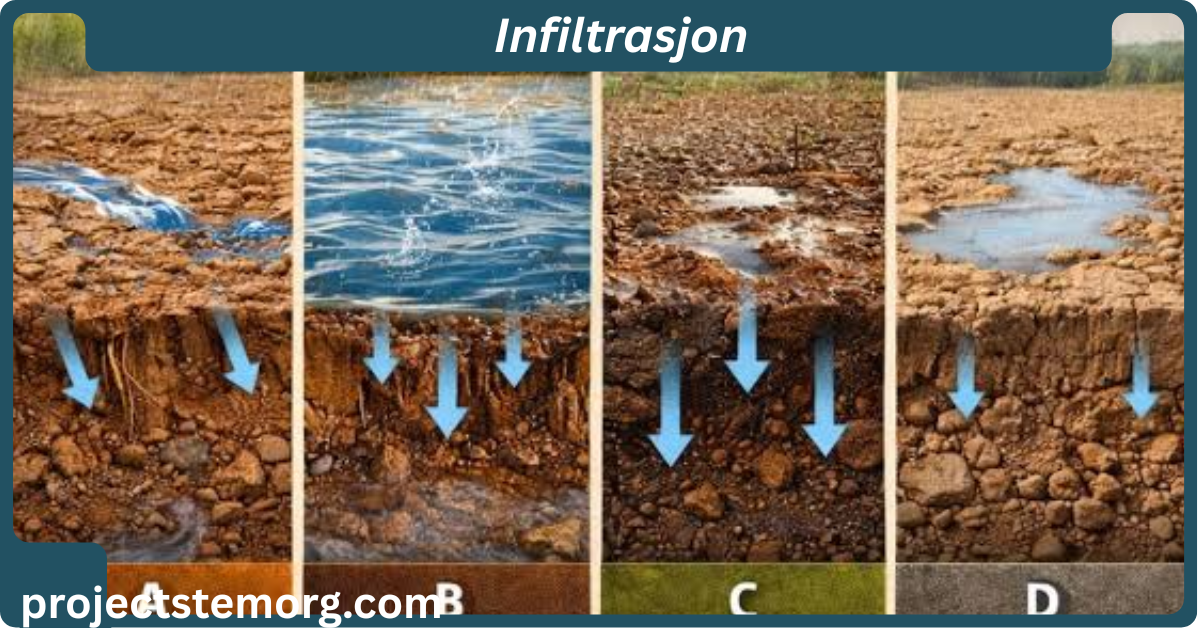
Infiltrasjon: How Rainwater Moves Into Soil, Reduces Runoff, and Supports Groundwater
Rain is one of the most important parts of the natural water cycle. When rain reaches the ground, it does not all behave in the same way. Some water flows across the surface, some evaporates, some is used by plants, and some enters the soil.
The movement of water from the ground surface into the soil is known as infiltrasjon, or infiltration.
Although infiltration sounds like a simple process, it has a major role in the health of the environment. It affects soil moisture, groundwater, plants, streams, flooding, erosion, and stormwater management. In cities, understanding infiltration has become even more important because roads, buildings, sidewalks, and parking areas can prevent rain from naturally entering the ground.
When infiltration works well, soil can act like a natural storage system. It temporarily holds rainwater and allows some of that water to move deeper into the ground. This can reduce the amount of water flowing over the surface during rainfall.
Infiltrasjon is therefore an important concept in hydrology, environmental science, agriculture, landscaping, construction, and urban planning.
This guide explains what infiltrasjon means, how it works, what affects the infiltration rate, how it connects to groundwater, and why it matters for safer and more sustainable stormwater systems.
What Is Infiltrasjon?
Infiltrasjon is the process through which water moves from the surface of the ground into the soil.
The easiest way to understand it is to imagine rain falling on a garden.
Some drops land on leaves. Some remain on the surface for a short time. Some flow toward a lower area. Other drops enter the spaces between soil particles.
Those drops entering the soil are undergoing infiltration.
Soil contains countless small spaces called pores. These spaces can hold air or water. When rain reaches the soil, water can enter these pores and move downward.
The speed of this process depends on the condition and type of soil.
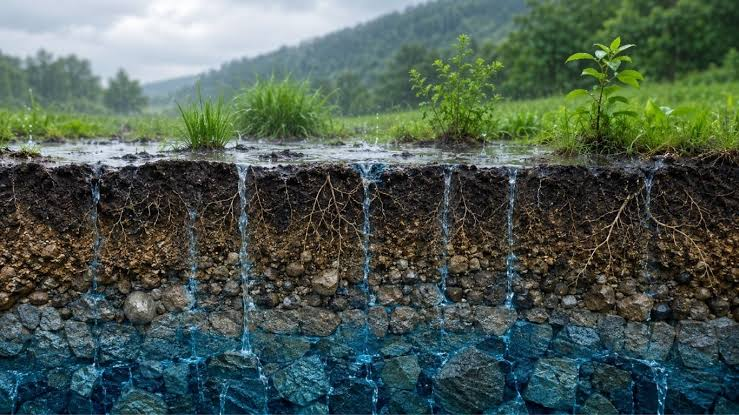
A loose, well-structured soil may allow water to enter quickly. A compacted soil may accept water much more slowly. A very wet soil may also have less room for additional water.
This is why infiltration is not simply about how much rain falls. It is about the relationship between rainfall and the soil’s ability to receive water.
How Does Infiltrasjon Work?
The process of infiltrasjon can be explained through several simple stages.
Rain Reaches the Ground
The process begins when precipitation reaches the land surface.
Rain can fall on many different surfaces, including:
- Grass
- Bare soil
- Forest floors
- Gardens
- Roads
- Sidewalks
- Parking areas
- Roofs
Each surface affects what happens next.
Natural soil usually provides opportunities for water to enter the ground. Hard surfaces usually prevent direct infiltration.
Water Begins Entering Soil
When rain reaches exposed soil, water starts moving into the spaces between soil particles.
The upper layer of soil may become wet first. As more water enters, the wet area gradually extends downward.
Also Read: nhentai.nef: The Keyword, Online Safety, Privacy, and Digital Awareness
The process may happen quickly during light or moderate rainfall when the soil has enough capacity to accept water.
Water Moves Through Soil
After entering the surface, water can continue moving through the soil.
Gravity is one important force involved in downward movement. Soil structure also influences the direction and speed of water movement.
Some water may remain near the surface. Some may move sideways. Some may reach deeper layers.
Plants Use Some of the Water
Plants depend on water stored in soil.
Roots can take up some infiltrated water. The water can then move through the plant and eventually return to the atmosphere through transpiration.
This means infiltration contributes to plant growth as well as the wider water cycle.
Some Water May Reach Groundwater
If water continues moving downward far enough, it may eventually reach the groundwater system.
This is one reason infiltration can support groundwater recharge.
However, not every drop that enters soil becomes groundwater. Some water remains stored in the soil, some is taken up by plants, and some eventually returns to the atmosphere.
Why Is Infiltrasjon Important?
Infiltrasjon is important because it helps control what happens to rain after it reaches the ground.
It influences several major environmental processes.
Infiltrasjon Reduces Surface Runoff
One of the biggest benefits of infiltration is that it can reduce surface runoff.
Surface runoff occurs when water moves across the land instead of entering the soil.
If a large amount of rain falls on a surface that cannot absorb water, runoff can quickly increase.
Infiltration gives some of that water another pathway.
Instead of immediately moving downhill, water can enter the soil and remain there temporarily.
Infiltrasjon Supports Groundwater
Groundwater is water stored below the ground.
Many communities depend on groundwater for drinking water, farming, industry, and other purposes.
Infiltration can help replenish groundwater when water moves downward through soil and reaches underground water-bearing areas.
This process is known as groundwater recharge.
The connection between infiltration and groundwater is particularly important in regions where groundwater provides a significant portion of the water supply.
Infiltrasjon Helps Reduce Flooding
Infiltration can help reduce the amount of rainwater that immediately becomes runoff.
This can be especially helpful during storms.
If soil, vegetation, and stormwater systems can temporarily store rainfall, less water may reach drainage systems at the same time.
However, infiltration cannot prevent every flood. Extremely heavy rainfall can exceed the capacity of soil and drainage systems.
Infiltrasjon Supports Vegetation
Healthy plants need water.
When rainfall enters the soil, some of that water becomes available to plant roots.
This can support grass, trees, crops, flowers, shrubs, and other vegetation.
Vegetation can also improve infiltration by protecting soil and creating root channels.
This creates a useful relationship between plants and soil.
Infiltrasjon Can Reduce Erosion
Fast-moving runoff can carry soil particles away.
This process is called erosion.
When more water enters the soil instead of rapidly flowing over the surface, runoff can sometimes be reduced.
Vegetation also helps protect soil from the direct impact of raindrops.
For these reasons, healthy soil and vegetation can work together to reduce erosion.
What Is the Infiltration Rate?
The infiltration rate is the speed at which water enters the soil.
It is often expressed as a measurement of water depth over a period of time.
For example, a soil may be described as having an infiltration rate measured in inches per hour.
The important point is that infiltration rate is not the same everywhere.
Different soils can behave very differently.
Even the same soil can have different infiltration rates depending on its condition.
For example, compacted soil may have a much lower infiltration rate than loose soil of the same general type.
What Is Infiltration Capacity?
Infiltration capacity refers to the maximum rate at which soil can accept water under particular conditions.
Think of soil as a container with an opening.
If water arrives slowly, the soil may be able to absorb most or all of it.
If water arrives extremely quickly, the soil may not be able to accept it at the same speed.
The extra water can then remain on the surface or become runoff.
This explains why a short, intense storm can create large amounts of runoff even in an area that normally absorbs rain well.
What Factors Affect Infiltrasjon?
Many factors influence how much water enters soil and how quickly it moves.
Soil Texture
Soil texture refers mainly to the proportions of sand, silt, and clay.
Sandy soils often have larger spaces between particles and can allow water to move relatively quickly.
Clay soils have much smaller particles and can have slower water movement.
However, texture is not the only factor.
Two soils with similar textures can behave differently because of differences in structure, organic matter, roots, compaction, and moisture.
Soil Structure
Soil structure describes how soil particles are arranged into groups or aggregates.
Good soil structure can create connected pathways for water.
Poor structure can restrict those pathways.
This is why soil structure is important when studying infiltration.
Soil Compaction
Compaction is one of the common causes of poor infiltration.
Heavy machinery, vehicles, construction activity, and repeated foot traffic can compress soil.
When soil becomes compacted, large pores may be reduced or closed.
This can make it harder for water to enter the ground.
Compacted soil may therefore produce more surface runoff.
Soil Moisture
The amount of water already present in the soil also matters.
A relatively dry soil may have more available space for new water.
A nearly saturated soil has less capacity to hold additional water.
This means infiltration behavior can change during the same rainfall event.
Vegetation
Plants can have a major influence on infiltration.
Roots create small pathways through soil.
Leaves and plant material can slow rainfall before it reaches the ground.
Vegetation also helps protect the soil surface from being damaged by heavy rainfall.
Grass, trees, shrubs, and other plants can therefore contribute to healthier soil conditions.
Organic Matter
Organic matter is another important part of soil health.
Organic material can improve soil structure and help soil hold moisture.
It can also support biological activity within the soil.
Healthy soil with good structure often provides better conditions for infiltration.
Rainfall Intensity
Rainfall intensity is one of the most important factors.
A slow rain may give soil enough time to absorb much of the water.
A sudden heavy storm can deliver water faster than the soil can accept it.
When rainfall exceeds infiltration capacity, runoff increases.
Slope
The slope of the land can influence how long water remains in contact with the soil.
On steep land, water may move downhill quickly.
On flatter land, water may have more time to infiltrate.
Slope is therefore an important factor in drainage and stormwater planning.
Surface Cover
What covers the ground makes a major difference.
Grass, mulch, forest litter, bare soil, concrete, and asphalt all behave differently.
Impervious surfaces such as concrete and asphalt generally prevent direct infiltration.
Infiltrasjon and Groundwater Recharge
Infiltration and groundwater recharge are closely related, but they are not the same thing.
Infiltration happens when water enters the soil.
Groundwater recharge occurs when water moves far enough downward to add water to an underground groundwater system.
There can be many steps between these two processes.
After rain enters the soil, the water may:
- Remain in the upper soil
- Move sideways
- Be absorbed by roots
- Evaporate
- Return to the atmosphere through plants
- Move into deeper soil
- Eventually reach groundwater
This distinction is important because it prevents a common misunderstanding.
Not every amount of infiltrated rain becomes groundwater.
Infiltration simply creates a pathway that can allow water to move below the surface.
Infiltrasjon and the Water Cycle
Infiltrasjon is one part of the larger water cycle.
The water cycle describes the continuous movement of water between the atmosphere, land, oceans, rivers, lakes, plants, soil, and underground systems.
Rainfall brings water to the land.
Some water infiltrates.
Some becomes runoff.
Some evaporates.
Plants absorb some of the water and release moisture through transpiration.
Water that moves into underground systems may eventually return to streams, springs, wetlands, or other parts of the water cycle.
This means infiltration is not an isolated process.
It connects the atmosphere, soil, plants, surface water, and groundwater.
Infiltrasjon vs. Runoff
Infiltration and runoff represent two different pathways for rainfall.
Infiltration moves water into the soil.
Runoff moves water across the surface.
Imagine two locations receiving the same amount of rain.
The first is a healthy grassy field.
The second is a large parking lot.
The grassy field may allow a significant portion of rainfall to enter the soil.
The parking lot cannot absorb water in the same way.
More rain therefore becomes surface runoff.
This simple comparison helps explain why urban development can dramatically change local drainage patterns.
Why Urban Areas Have Infiltration Problems
Natural landscapes usually contain soil and vegetation that can receive rainfall.
Cities contain large amounts of impervious surfaces.
These may include:
- Roads
- Sidewalks
- Parking lots
- Driveways
- Buildings
- Rooftops
- Concrete surfaces
When natural ground is replaced with these surfaces, less rainfall can enter the soil where it falls.
More water may instead flow toward gutters, drains, channels, and streams.
During heavy storms, this can put pressure on stormwater infrastructure.
Urban planners therefore increasingly consider infiltration when designing new developments and improving existing neighborhoods.
Also Read: Masgonzola: A Complete Guide to This Creamy Gorgonzola and Mascarpone Cheese
Infiltrasjon and Stormwater Management
Stormwater is rainwater or melted snow that flows across surfaces.
Managing stormwater is important because uncontrolled runoff can contribute to flooding, erosion, pollution, and drainage problems.
Traditional stormwater systems often focus on collecting water and moving it away.
Modern approaches may also focus on slowing, storing, filtering, and infiltrating water.
This can include natural and engineered systems.
Examples include:
- Rain gardens
- Infiltration basins
- Infiltration trenches
- Permeable pavement
- Vegetated swales
- Green spaces
- Tree systems
- Bioretention areas
These approaches can help keep some rainfall closer to where it lands.
How Rain Gardens Support Infiltrasjon
A rain garden is a shallow planted area designed to receive stormwater.
Water may enter a rain garden from a roof, driveway, walkway, or nearby surface.
The garden temporarily holds the water.
The water can then move into the soil.
Plants also use some of the available moisture.
A properly designed rain garden can therefore combine several natural processes:
- Temporary storage
- Infiltration
- Plant uptake
- Evapotranspiration
- Filtration
Rain gardens are often relatively small, but many small systems across a neighborhood can collectively affect local stormwater behavior.
How Infiltration Basins Work
An infiltration basin is a shallow area designed to temporarily collect stormwater.
Instead of sending all the water immediately into a pipe, the basin provides space for water to remain temporarily while it infiltrates into the underlying soil.
These systems work best when the site has suitable soil and groundwater conditions.
They may not be appropriate in every location.
A professional site assessment may be needed before designing one.
How Infiltration Trenches Work
An infiltration trench is a narrow underground or surface-level stormwater structure designed to temporarily store runoff.
Many systems contain stone or gravel.
Water enters the trench and fills the spaces between the materials.
It can then gradually move into surrounding soil.
Infiltration trenches can be useful where available land is limited, but they require appropriate design and maintenance.
Sediment can eventually reduce their effectiveness if the system is not properly protected.
Permeable Pavement and Infiltrasjon
Traditional pavement is designed to stop water from entering the ground.
Permeable pavement takes a different approach.
It contains materials or openings that allow water to pass through the surface.
The water can then enter a storage layer beneath the pavement before moving into the surrounding soil.
Permeable pavement can be useful for certain parking areas, walkways, driveways, and other suitable locations.
However, the design needs to consider soil type, expected traffic, drainage, maintenance, and local weather.
Can Infiltrasjon Improve Water Quality?
Infiltration can sometimes help improve stormwater quality because soil can trap or transform certain pollutants.
As water moves through soil, some particles may be filtered or retained.
Plants and microorganisms can also contribute to natural treatment processes.
However, infiltration is not a guarantee of clean groundwater.
Stormwater may contain pollutants from roads, vehicles, industrial areas, construction sites, fertilizers, and other sources.
If contaminated water is allowed to infiltrate without proper controls, pollutants can potentially move into groundwater.
This is why stormwater quality is just as important as stormwater quantity.
Can Infiltrasjon Cause Groundwater Contamination?
It can under certain conditions.
This does not mean infiltration itself is dangerous.
The risk depends on what is in the water, the soil, the geology, the depth of groundwater, and the design of the infiltration system.
Extra care may be needed near:
- Industrial properties
- Fuel stations
- Vehicle maintenance areas
- Contaminated land
- Chemical storage areas
- Certain agricultural operations
- Shallow groundwater
- Highly permeable soils
Stormwater should be evaluated before it is intentionally directed into the ground in sensitive locations.
Infiltrasjon in Residential Areas
Homeowners can sometimes improve natural infiltration through simple landscape choices.
Maintaining healthy vegetation is one example.
Avoiding unnecessary soil compaction is another.
Homeowners may also use landscaped areas, rain gardens, or suitable permeable surfaces to manage rainfall.
However, water should never be intentionally directed toward a building foundation or another location where infiltration could create structural or drainage problems.
Local soil and drainage conditions should always be considered.
Infiltrasjon in Agriculture
Agriculture depends heavily on the relationship between rainfall, soil, and water storage.
Good infiltration can help move rainfall into the root zone.
This can provide plants with access to moisture between rainfall events.
However, excessive runoff can remove valuable topsoil and nutrients.
Agricultural practices that protect soil structure and reduce unnecessary compaction can therefore support better water management.
Examples may include maintaining vegetation, managing traffic on fields, protecting soil from erosion, and using appropriate soil-management practices.
Infiltrasjon and Soil Health
Infiltration is closely connected to soil health.
Healthy soil contains a mixture of mineral particles, organic matter, water, air, roots, and living organisms.
These components help create a network of spaces through which water can move.
Poorly managed soil may become compacted, damaged, or structurally weak.
When that happens, infiltration can decline.
This creates a cycle in which more water becomes runoff, which may increase erosion and further damage soil.
Protecting soil structure can therefore have benefits beyond infiltration alone.
How Is Infiltrasjon Measured?
Scientists, engineers, farmers, and environmental professionals can measure infiltration in several ways.
One common approach involves applying water to a known area and measuring how quickly it enters the soil.
Different field tests can be used depending on the project.
Measurements may help determine:
- Infiltration rate
- Soil drainage behavior
- Suitability for stormwater systems
- Potential ponding
- Expected water storage
- Design requirements
For large projects, field testing may be combined with soil surveys, groundwater information, geological data, and computer modeling.
Why Site Testing Matters
A common mistake is assuming that all soil in an area behaves the same way.
In reality, soil conditions can change significantly over short distances.
One part of a property may drain quickly while another part holds water.
Construction can also alter soil conditions.
Imported soil, compacted areas, buried materials, and disturbed soil layers may behave differently from natural soil.
This is why site-specific testing can be valuable when designing an infiltration system.
Infiltrasjon Modeling
Computer models can help predict how rainfall will move through a drainage area.
A model can consider information such as:
- Rainfall
- Land area
- Soil conditions
- Impervious surfaces
- Drainage systems
- Storage areas
- Infiltration
- Runoff
Modeling can help engineers compare different stormwater designs.
For example, they might compare a traditional drainage system with one that includes rain gardens and infiltration areas.
The purpose is not simply to maximize infiltration.
Instead, the goal is to understand how water behaves and create a system that remains safe under expected conditions.
Common Problems That Reduce Infiltrasjon
Several problems can make infiltration less effective.
Compacted Soil
Compaction reduces pore space and can slow water movement.
Impervious Surfaces
Concrete and asphalt prevent direct contact between rainfall and soil.
Poor Soil Structure
Damaged soil structure can reduce connected pathways for water.
Excessive Sediment
Fine particles can clog infiltration systems.
Saturated Soil
Soil that is already filled with water has less capacity for additional rainfall.
Shallow Groundwater
A shallow water table may limit how much additional water can move downward.
Contaminated Runoff
Polluted water can create groundwater-quality concerns.
Lack of Maintenance
Leaves, trash, sediment, and plant overgrowth can interfere with stormwater systems.
How to Improve Infiltrasjon Naturally
Improving infiltration does not always require complicated technology.
Several basic practices can help.
Protect the Soil
Avoid unnecessary compaction.
Keep Plants Growing
Vegetation protects the surface and supports soil structure.
Add Organic Material When Appropriate
Organic matter can support soil health and improve soil structure.
Reduce Unnecessary Hard Surfaces
Where practical, replacing some impervious surfaces with suitable planted or permeable areas can create more opportunities for infiltration.
Protect Root Systems
Tree and plant roots can contribute to soil structure.
Manage Stormwater Near Its Source
Allowing suitable rainfall to enter landscaped areas can reduce the amount of water that must travel through drainage systems.
Infiltrasjon and Climate Resilience
Communities are increasingly interested in ways to manage intense rainfall and changing weather patterns.
Infiltration is one tool that can contribute to climate-resilient stormwater management.
By increasing temporary water storage in soil and reducing some surface runoff, infiltration-based systems can provide additional capacity during rainfall.
However, infiltration should not be viewed as a complete solution.
Large storms can overwhelm individual systems.
Good resilience planning combines infiltration with drainage, detention, safe overflow pathways, vegetation, infrastructure improvements, and emergency planning.
Is More Infiltrasjon Always Better?
No.
This is an important point.
It may sound logical to think that the best stormwater system is the one that puts the greatest possible amount of water into the ground.
That is not always true.
The correct amount of infiltration depends on the location.
A site with contaminated soil may not be suitable for certain infiltration practices.
A site with a very shallow groundwater table may require additional precautions.
A site near a building foundation may have structural concerns.
A site with extremely slow-draining soil may require another stormwater solution.
The goal is safe and effective water management, not maximum infiltration at any cost.
Also Read: Bumetro: A Complete Guide to Smart Urban Mobility and Connected City Travel
Infiltrasjon and Sustainable Urban Design
Modern urban design increasingly recognizes that natural water processes have value.
Instead of treating rain as something that must immediately disappear into a storm drain, planners can sometimes design neighborhoods where water is managed closer to its source.
Trees, parks, rain gardens, green spaces, permeable surfaces, and other features can help create a more natural relationship between rainfall and the landscape.
This approach can also provide benefits beyond water management.
Green areas may improve outdoor spaces, support plants and wildlife, reduce heat, and make neighborhoods more pleasant.
The Future of Infiltrasjon
As cities grow and rainfall management becomes more important, infiltration will continue to be an important part of environmental planning.
Technology can also improve how infiltration systems are designed and monitored.
Sensors, geographic information systems, rainfall data, hydrologic models, and improved soil mapping can help professionals understand water movement more accurately.
At the same time, simple natural systems will remain important.
A healthy soil profile, mature vegetation, and well-designed landscape can perform valuable water-management functions without requiring complicated machinery.
The future of stormwater management will likely involve a combination of natural processes and engineered infrastructure.
Frequently Asked Questions About Infiltrasjon
1. What happens to infiltrated water after it enters the soil?
After water enters the soil, several things can happen. It may remain stored in soil pores, move downward, move sideways, be absorbed by plant roots, evaporate, or eventually reach groundwater. The final pathway depends on soil conditions, weather, vegetation, geology, and groundwater levels.
2. Does dry soil always have a high infiltration rate?
No. Dry soil can sometimes accept water quickly at first, but the actual infiltration rate depends on soil structure, texture, compaction, cracks, vegetation, and other conditions. Very dry or hydrophobic soils can sometimes behave differently from what might be expected.
3. Why does water sometimes sit on the ground instead of infiltrating?
Surface water can remain on the ground when rainfall arrives faster than the soil can absorb it. Compacted soil, clay-rich conditions, saturated soil, frozen ground, poor drainage, and an impermeable surface can all contribute to ponding.
4. Can trees affect infiltration?
Yes. Trees can influence infiltration through their roots, leaf litter, and effects on soil structure. Root channels can provide pathways for water, while vegetation protects soil from rainfall impact. However, the effect varies according to tree species, soil condition, landscape design, and local climate.
5. Can infiltration systems work without maintenance?
Most engineered infiltration systems require some maintenance. Sediment, leaves, trash, vegetation growth, and other materials can reduce performance over time. Regular inspection helps identify problems before they become major failures.
Conclusion
Infiltrasjon is a simple natural process with a powerful role in the water cycle. It occurs when water moves from the surface into the soil, creating an important connection between rainfall, soil moisture, plants, groundwater, and runoff.
Good infiltration can help reduce surface runoff, support groundwater recharge, provide water for vegetation, and reduce pressure on stormwater systems. It can also contribute to erosion control and healthier landscapes.
At the same time, infiltration is not the same everywhere. Soil type, soil structure, compaction, vegetation, rainfall intensity, slope, groundwater conditions, and land use all influence how water moves.
This is particularly important in cities. Roads, buildings, parking lots, and other impervious surfaces can prevent rain from naturally entering the ground. Infiltration-based solutions such as rain gardens, infiltration basins, infiltration trenches, permeable pavement, and vegetated areas can help restore some of the natural functions that development removes.
But effective stormwater management is not about forcing as much water as possible into the ground. It is about understanding the local environment and managing water safely.
The most useful way to think about infiltrasjon is as a natural bridge between rainfall and the land beneath our feet. When soil is healthy and water is managed carefully, that bridge can help communities reduce runoff, protect natural resources, support groundwater, and create more resilient landscapes.