GrowQuip: Meaning, History, Horticulture Events, and What the Name Refers To
GrowQuip is a name associated with commercial horticulture, growing technology, agricultural equipment, and industry networking. The term has appeared in more than one horticultural context, so it is important to understand which GrowQuip a person means when searching for it online.
The best-documented use of GrowQuip was a commercial horticulture conference and industry showcase organized by the Commercial Horticultural Association (CHA) in the United Kingdom. The event was designed for professional growers working with fruit, vegetables, salads, and ornamental plants. It brought together growers, suppliers, technical experts, and other people involved in commercial horticulture.
GrowQuip is therefore not best understood as a general gardening website or a consumer gardening brand. Its documented history is closely connected with professional horticulture and the businesses, technologies, and ideas used to grow crops commercially.
The name can also appear in older horticultural equipment records. For example, a UK horticultural research document lists Growquip Ltd among companies associated with horticultural production equipment.
Because much of the publicly available information about GrowQuip comes from the 2016–2017 period, readers should be careful when interpreting old search results as evidence of a current event, active company, or current service.
GrowQuip Meaning Explained Simply
The word “GrowQuip” can be understood as a combination of “grow” and “equipment.”
That makes the name especially suitable for horticulture.
“Grow” relates to growing plants and crops, while “quip” can suggest equipment or tools. However, the exact meaning depends on the context in which the name is being used.
In historical event coverage, GrowQuip referred to a commercial horticulture conference and exhibition rather than one specific piece of equipment.
This distinction is important because someone searching for GrowQuip today may encounter references to:
- Commercial horticulture
- Greenhouse growing
- Agricultural equipment
- Plant production
- Crop technology
- Horticultural suppliers
- Irrigation
- Growing systems
- Crop monitoring
- Industry conferences
- Professional growers
These subjects are connected, but they are not necessarily references to one current GrowQuip business.

The History of GrowQuip
The documented GrowQuip event was introduced by the Commercial Horticultural Association in 2016.
Also read:Who Is Shani Levni and What Is Known About This Name?
The first event was held on October 26–27, 2016, at the Stratford Manor Hotel in Stratford-upon-Avon, Warwickshire. It was described as an international conference and exhibition for the commercial horticultural industry.
The event focused on the practical challenges facing professional growers.
Rather than concentrating on only one crop, GrowQuip was designed as a cross-industry event. This meant that growers from different parts of horticulture could learn from each other.
The event covered growers involved in fruit, vegetables, salads, and ornamental plants.
That broad approach was one of the main ideas behind GrowQuip.
What Was the GrowQuip Conference?
The GrowQuip conference was created as a professional event for the commercial horticulture industry.
Its purpose was to give growers access to ideas, expert speakers, industry information, products, services, and networking opportunities.
The organizers presented it as an event that could help growers deal with common business and production challenges.
Topics connected with commercial horticulture can include:
- Crop production
- Plant health
- Pest management
- Greenhouse technology
- Irrigation
- Growing media
- Fertilization
- Environmental monitoring
- Crop quality
- Labor
- Productivity
- Business management
- Market conditions
- New horticultural technologies
The exact program changed between editions, but the broader goal was to connect different parts of the horticultural supply chain.
When Was GrowQuip Held?
The first documented GrowQuip conference took place in 2016.
The event was held over two days and included a conference, networking activities, and an industry showcase. The second edition was announced for November 1–2, 2017, again in Stratford-upon-Avon.
The 2017 edition continued the cross-industry approach.
Reports described GrowQuip as an event for growers of fruit, vegetables, salads, and ornamentals.
This historical information is useful because it explains why searches for “GrowQuip” may produce older conference pages instead of a current event calendar.
Where Was GrowQuip Held?
The documented GrowQuip conferences were held at the Stratford Manor Hotel in Stratford-upon-Avon, Warwickshire, England.
The 2016 event was held there on October 26–27, while the 2017 event was scheduled for November 1–2 at the same venue.
This means GrowQuip’s best-documented event history is connected with the United Kingdom rather than the United States.
For a U.S. reader, this is an important distinction.
If you see a webpage describing GrowQuip as a current U.S. agricultural event, it is worth checking the date and organizer before assuming that it is connected to the historical UK conference.
Who Organized GrowQuip?
The Commercial Horticultural Association, commonly known as CHA, organized the documented GrowQuip conference.
The association worked with sponsors, exhibitors, and other horticultural organizations to create a professional event for commercial growers.
Historical coverage states that GrowQuip received support from organizations including the Horticultural Trades Association and the International Association of Horticultural Producers.
This industry support helps explain the professional focus of the event.
GrowQuip was not designed simply as a public gardening show.
It was aimed at people working in commercial horticulture.
Who Was GrowQuip For?
GrowQuip was primarily relevant to professional growers and businesses involved in horticulture.
Its audience could include:
- Fruit growers
- Vegetable growers
- Salad producers
- Ornamental plant growers
- Greenhouse operators
- Horticultural suppliers
- Plant producers
- Agricultural technology companies
- Equipment suppliers
- Crop consultants
- Researchers
- Industry organizations
The event’s cross-industry structure was particularly useful because different growing sectors often face similar problems.
For example, a technology developed for one crop may eventually provide ideas for another crop.
This type of knowledge sharing is valuable in commercial agriculture.
Why Commercial Horticulture Needs Events Like GrowQuip
Commercial growing is more complex than simply planting seeds and waiting for plants to grow.
Professional growers have to manage biological, environmental, technical, financial, and labor-related challenges.
A commercial grower may need to think about:
- Water availability
- Fertilizer costs
- Energy prices
- Labor costs
- Crop diseases
- Insect pests
- Weather
- Greenhouse conditions
- Crop quality
- Harvest timing
- Transportation
- Market demand
- Production costs
A conference can bring different specialists together to discuss these problems.
That is one reason industry events can be valuable even when the participants already have years of practical experience.
GrowQuip and Horticultural Technology
One of the important themes surrounding GrowQuip was the use of technology to improve commercial growing.
Modern horticulture increasingly depends on tools that help growers measure and control growing conditions.
Examples include:
- Environmental sensors
- Irrigation systems
- Fertigation equipment
- Climate-control systems
- Crop monitoring
- Automated greenhouse systems
- Data collection
- Weather stations
- Growing media technology
- Energy-management systems
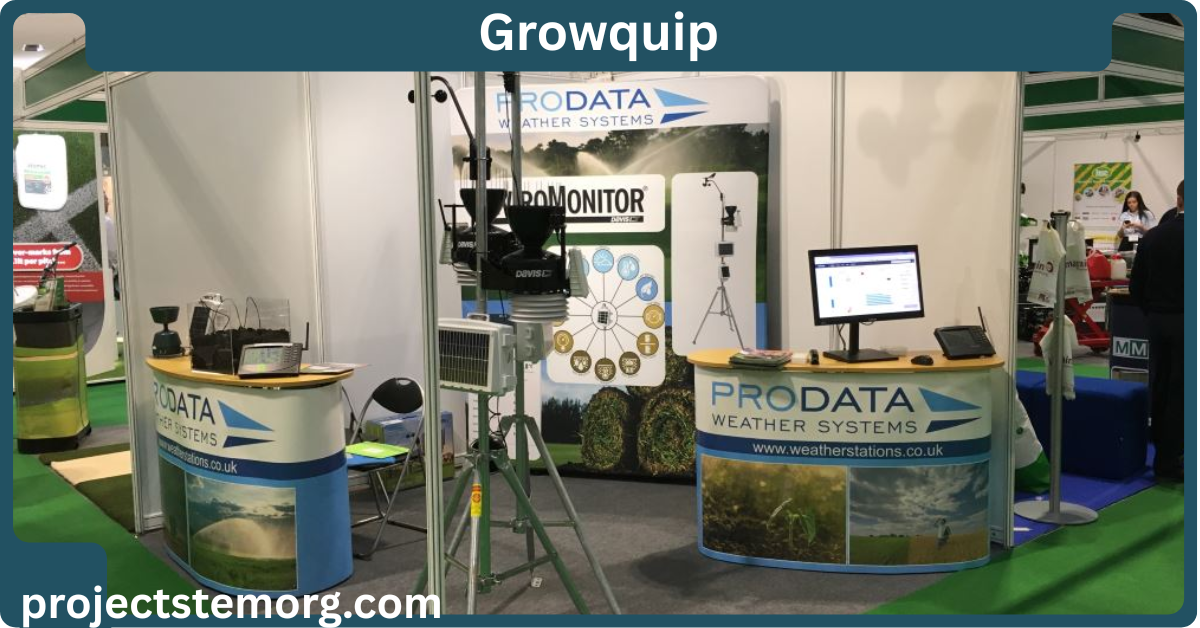
Historical reports from the GrowQuip period show exhibitors presenting products and technologies intended for professional growers.
For example, an EnviroMonitor system demonstrated around the 2017 event used a gateway, sensor nodes, and a cloud-based system to provide environmental information through computers and mobile devices.
This illustrates an important trend in horticulture: technology can turn growing conditions into measurable data.
GrowQuip and Greenhouse Growing
Greenhouse production is one area where commercial horticultural technology can be especially important.
A greenhouse gives growers greater control over the growing environment than completely outdoor production.
Depending on the greenhouse design, growers can manage factors such as:
- Temperature
- Humidity
- Ventilation
- Irrigation
- Light
- Nutrient delivery
- Air movement
- Carbon dioxide levels
The goal is not simply to control everything perfectly.
Instead, the goal is often to create conditions that support healthy crop growth while controlling production costs.
This balance is critical.
A technology that improves crop growth but costs too much to operate may not provide a useful commercial return.
GrowQuip and Irrigation Technology
Water management is a major part of commercial horticulture.
Too little water can reduce plant growth and crop quality.
Too much water can contribute to root problems, nutrient loss, disease conditions, and wasted resources.
Modern irrigation systems can help growers deliver water more accurately.
Some systems can also combine irrigation with fertilizer delivery.
This process is often called fertigation.
Historical references to Growquip equipment include fertilizer injectors in horticultural production records, showing that the Growquip name has also appeared in connection with growing equipment.
However, this does not necessarily mean every reference to GrowQuip online describes the same company or organization.
That is an important point when researching the term.
GrowQuip and Crop Monitoring
Crop monitoring is another important part of modern horticulture.
Growers cannot always rely only on visual observation.
Sensors can help collect information about environmental conditions.
Depending on the system, growers may monitor:
- Temperature
- Humidity
- Soil or growing-medium conditions
- Water conditions
- Weather
- Light
- Other environmental measurements
Data can help growers identify changes earlier.
For example, if greenhouse temperature rises beyond a desired range, monitoring technology may alert the grower.
This does not eliminate the need for human judgment.
Instead, it gives growers more information for making decisions.
GrowQuip and Vertical Farming
Vertical farming is another area related to modern horticultural technology.
Although vertical farming is not synonymous with GrowQuip, research based on information presented at the 2017 GrowQuip conference has discussed controlled growing systems and potential productivity improvements.
One academic study examined information from trials presented at GrowQuip and discussed how certain growing systems could increase yields per unit of land.
This is an example of why historical conference material can remain useful even after an event has ended.
Ideas presented at industry events may later appear in academic research, business planning, or technology development.
GrowQuip and Sustainable Horticulture
Sustainability is increasingly important in commercial horticulture.
Growers need to produce crops efficiently while managing natural resources and operating costs.
Sustainable horticulture can involve:
- Efficient water use
- Reduced waste
- Better nutrient management
- Integrated pest management
- Renewable energy
- Efficient heating
- Improved growing media
- Recycling
- Soil health
- Reduced chemical use where appropriate
However, sustainability is not simply about using the newest technology.
A system should also make economic sense for the grower.
A technology that uses fewer resources but costs far more than the farm can reasonably afford may not be practical.
This is why commercial growers often need to consider both environmental and financial sustainability.
Why GrowQuip May Appear in Old Search Results
If you search for GrowQuip today, you may notice that many results are several years old.
There is a simple reason.
The most clearly documented GrowQuip event history comes from 2016 and 2017.

Search engines can continue to display those pages because they contain useful historical information.
Also read:Apposed vs Opposed: Meaning, Difference, Usage, and Examples
An old page appearing near the top of search results does not necessarily mean the event is currently active.
This is an important lesson in online research.
Search ranking and current status are not the same thing.
Is GrowQuip Still Active?
Based on the publicly available sources located for this article, the strongest documentation concerns GrowQuip’s historical commercial horticulture events in the UK.
The sources reviewed do not establish a current 2026 GrowQuip conference schedule.
Therefore, it would be inaccurate to claim that GrowQuip is currently operating as the same conference without newer evidence.
This distinction is especially important for people searching for:
- GrowQuip tickets
- GrowQuip 2026
- GrowQuip events
- GrowQuip conference dates
- GrowQuip exhibitors
- GrowQuip registration
Older event pages should not automatically be treated as current registration information.
Is GrowQuip a Company?
The answer depends on which historical reference is being discussed.
A UK horticultural research document from the early 2000s lists “Growquip Ltd” as a horticultural company and provides contact information associated with horticultural production.
Separately, the Commercial Horticultural Association used “GrowQuip” as the name of a commercial horticulture conference and showcase in 2016 and 2017.
These references should not automatically be merged into one organization.
This is one of the most important facts to understand when researching GrowQuip online.
A similar name can refer to different things at different times.
Why Name Confusion Matters
Online searches often combine information from different years, countries, and organizations.
A company name may be reused.
A product name may become a brand name.
An event name may later disappear.
A domain name may also remain online even after a business or event has changed.
Therefore, researching GrowQuip requires attention to:
- Date
- Country
- Organization
- Address
- Industry
- Website ownership
- Event organizer
- Publication date
This approach reduces the risk of confusing unrelated references.
GrowQuip and the U.S. Audience
For readers in the United States, GrowQuip is mainly relevant as an example of commercial horticultural networking and technology rather than as a clearly established current U.S. event.
American growers interested in similar subjects may encounter related terms such as:
- Commercial greenhouse technology
- Controlled environment agriculture
- Controlled environment horticulture
- Agricultural technology
- Precision agriculture
- Smart irrigation
- Crop sensors
- Greenhouse automation
- Vertical farming
- Hydroponics
- Horticultural equipment
- Farm management technology
These areas cover many of the same broad subjects associated with commercial horticulture events.
What Can Growers Learn From the GrowQuip Concept?
The larger lesson from GrowQuip is that horticulture benefits from cross-industry knowledge sharing.
A grower does not need to work with the same crop as another grower to learn something useful.
For example, a technology designed for greenhouse vegetables may inspire an idea for ornamental plant production.
A monitoring system developed for one production environment may also be useful elsewhere.
This type of knowledge transfer can help businesses solve problems more efficiently.
GrowQuip and Industry Networking
Networking was an important part of the documented GrowQuip format.
The event included opportunities for delegates and suppliers to meet and exchange information. Historical coverage reported that attendees valued the networking opportunities and the chance to make useful industry contacts.
Networking can be especially important in specialized industries.
A grower may discover:
- A new supplier
- A technical consultant
- A new growing system
- A potential business partner
- A research connection
- A useful piece of equipment
- A new market idea
Professional events can therefore create value beyond the presentations themselves.
GrowQuip and Industry Exhibitions
The exhibition component allowed participants to see products and services from horticultural suppliers.
This is useful because technical information can be easier to understand when growers can see equipment directly.
An exhibition may allow visitors to compare:
- Equipment
- Sensors
- Irrigation systems
- Growing materials
- Technology platforms
- Crop-support products
- Environmental monitoring systems
For commercial growers, seeing a technology in person can be very different from reading a product description online.
What Made GrowQuip Different From a General Gardening Show?
A general gardening show may focus heavily on home gardeners, landscaping, plants, garden products, and consumer education.
GrowQuip had a more professional commercial focus.
Its audience included businesses and professionals involved in producing crops at scale.
That means the questions being discussed were often more business-focused.
For example:
A home gardener may ask, “How can I grow healthier tomatoes?”
A commercial grower may ask, “How can I increase tomato production while reducing water, labor, and energy costs?”
The second question requires a very different approach.
GrowQuip and Business Decisions
Commercial horticulture involves constant decisions about cost and productivity.
Suppose a grower considers installing an environmental monitoring system.
The grower should not only ask whether the system works.
They should also ask:
- What does it cost?
- How much maintenance does it require?
- What problem does it solve?
- How accurate is the information?
- How often will the data be used?
- Can it integrate with existing systems?
- Will it save labor?
- Can it reduce crop losses?
- Does it improve decision-making?
This type of practical thinking is more important than simply purchasing the newest technology.
How to Research GrowQuip Safely Online
If you encounter a website or social media page using the GrowQuip name, check the information carefully.
Look for a clear:
- Organization name
- Physical location
- Date
- Contact information
- Business registration information when relevant
- Privacy policy
- Terms and conditions
- Independent references
- Industry affiliations
Be especially careful with websites that make strong claims but provide little information about who operates them.
A familiar-looking name does not automatically prove that a website is connected with the historical GrowQuip event.
Is GrowQuip Safe to Search For?
Searching for the term itself is not inherently dangerous.
The main issue is determining whether a particular website, advertisement, social account, or business using the name is legitimate.
Users should avoid entering sensitive information into unfamiliar websites simply because they contain a recognizable keyword.
Do not provide unnecessary:
- Passwords
- Banking information
- Payment-card information
- Government identification
- Account recovery codes
- Private personal information
This is basic digital safety, but it is especially important when an old or ambiguous brand name is involved.
GrowQuip and Online Privacy
If you find a current website using the GrowQuip name, review its privacy practices before creating an account or submitting information.
A trustworthy website should explain what information it collects and how it is used.
Pay attention to whether it requests information that seems unrelated to the service.
For example, a basic informational website normally should not need highly sensitive personal details.
Users should also check whether the website uses secure connections and whether its contact details are consistent with information found elsewhere.
Why Current Information Matters
One of the biggest problems with researching older organizations and events is outdated information.
An address from 2016 may no longer be valid.
An email address may no longer work.
A conference may no longer exist.
A company may have changed ownership.
A website may have changed purpose.
Therefore, historical information should be labeled as historical rather than presented as current fact.
This is particularly important for people searching for GrowQuip in 2026.
GrowQuip Search Intent Explained
People searching for “GrowQuip” may have different intentions.
Some may want to know:
“What is GrowQuip?”
Others may be looking for:
- GrowQuip conference
- GrowQuip horticulture
- GrowQuip equipment
- GrowQuip company
- GrowQuip UK
- GrowQuip event
- GrowQuip history
- GrowQuip 2017
- GrowQuip agriculture
- GrowQuip greenhouse technology
These searches should not all be answered in exactly the same way.
Someone researching the historical event needs dates and organizers.
Also read:Babeltee: What It Means, How It Is Used, and Why the Term Is Gaining Attention
Someone researching horticultural equipment needs product information.
Someone searching for a current business needs current company information.
Understanding search intent helps prevent misleading answers.
GrowQuip and Semantic SEO Terms
When people search for GrowQuip, related terms can help explain the broader subject.
Important semantic terms include:
- Commercial horticulture
- Horticultural technology
- Agricultural equipment
- Greenhouse technology
- Crop production
- Plant production
- Irrigation
- Fertigation
- Crop monitoring
- Controlled environment agriculture
- Precision agriculture
- Horticultural suppliers
- Growing systems
- Environmental sensors
- Crop management
- Plant health
- Sustainable agriculture
- Agricultural innovation
These terms help explain why GrowQuip appeared in professional horticultural discussions.
The Importance of Verifying Old Event Information
A common online mistake is to copy old information and present it as new.
For GrowQuip, this could lead to incorrect claims about current conference dates or registration.
Historical sources clearly document the 2016 and 2017 events.
However, that does not prove that the same event is taking place today.
Good research separates three things:
- What happened in the past.
- What can be confirmed today.
- What cannot currently be confirmed.
That approach is especially important for SEO content because readers should receive accurate information rather than recycled claims.
Why GrowQuip Still Matters
Even though the documented GrowQuip conference history is several years old, the subjects it focused on remain relevant.
Commercial growers still need to improve:
- Productivity
- Resource efficiency
- Crop quality
- Labor efficiency
- Technology adoption
- Environmental monitoring
- Business performance
Modern agriculture continues to explore ways to combine biological knowledge with technology.
That makes the broader GrowQuip concept useful when studying the development of commercial horticulture.
What GrowQuip Teaches About Modern Horticulture
The history of GrowQuip shows that modern horticulture is about much more than growing plants. Today, successful commercial growers also need to understand technology, business, data, and teamwork. Plant science helps growers understand how crops grow, while modern equipment and greenhouse systems can make growing more efficient.
Data can help growers monitor important conditions and make better decisions. Business skills are also important because growers need to manage costs, labor, and resources. Marketing helps connect crops with customers and markets. Sustainability is another important part of modern horticulture because growers need to use water, energy, and other resources carefully.
Bringing all these areas together can help growers produce healthy crops while managing costs and resources. This combination of plant knowledge, technology, business, and sustainability is one of the main challenges and opportunities in modern horticulture.
Frequently Asked Questions About GrowQuip
Is GrowQuip a gardening website?
Not necessarily. The most clearly documented use of GrowQuip refers to a professional commercial horticulture conference and industry showcase in the UK. The name has also appeared in older horticultural equipment records, so context is important.
Was GrowQuip held in the United States?
The documented GrowQuip conference was held in Stratford-upon-Avon, Warwickshire, England. The 2016 and 2017 editions were UK events.
What industries were represented at GrowQuip?
GrowQuip focused on commercial horticulture, including fruit, vegetable, salad, and ornamental plant production. Suppliers, growers, consultants, and other industry professionals could participate.
Does GrowQuip have a current 2026 event?
The sources reviewed for this article document GrowQuip events from 2016 and 2017, but they do not establish a current 2026 event schedule. Readers should verify any modern GrowQuip announcement directly with the organization behind it before making plans or payments.
Why does GrowQuip appear in horticultural research?
GrowQuip brought commercial growers, suppliers, and technology providers together. Information presented at the conference has also appeared in later academic discussion, including research examining controlled growing systems and productivity.
Conclusion
GrowQuip is a term with a documented connection to commercial horticulture, horticultural equipment, and professional industry networking. Most of the strongest publicly available information concerns the GrowQuip conference organized by the Commercial Horticultural Association in the UK in 2016 and 2017. The event focused on commercial growers of fruit, vegetables, salads, and ornamental plants and provided opportunities to learn about growing technology, products, services, business challenges, and industry developments.
The name can also appear in older records connected with horticultural equipment, which means researchers should avoid assuming that every online reference to GrowQuip represents the same organization.
For anyone searching for GrowQuip today, the most important point is to separate historical information from current information. Older conference pages can explain the history of the name, but they should not automatically be treated as proof of a current event or active service. This careful approach provides a more accurate understanding of GrowQuip and the wider world of commercial horticulture.